Race strategy,
decided by six agents.
F1 StratLab is an open-source multi-agent AI system for real-time Formula 1 race strategy. It orchestrates seven ML models and a LangGraph multi-agent system to produce strategy recommendations — from lap time prediction to tire degradation, radio NLP, and RAG over FIA regulations.
From raw lap to race-ready call.
A LangGraph ReAct multi-agent system replaces the legacy Experta rule engine. Six specialised sub-agents coordinate under a Strategy Orchestrator.
- FastF1 · OpenF1
- Lap telemetry
- Team radios
- FIA race control
- Pace
- Tire
- Race Situation
- Pit Strategy
- Radio
- RAG
- MoE dynamic routing
- Monte Carlo simulation
- Pydantic v2 output
- LLM synthesis
- perform_undercut
- extend_stint
- prepare_pit
- defensive_pit
- push_strategy
Six specialists. One table.
Each sub-agent reasons in its own head, outputs structured Pydantic predictions, and hands them to the orchestrator.
Pace Agent
What happened. What's next.
The field, in real time.
The orchestrator sees every car's sector pace, gap delta, and compound — and recomputes every lap.
One recommendation.
The orchestrator weighs the six opinions against FIA rules and simulation, and returns the call.
Seven models.
One decision.
Each sub-agent wraps one or more models as @tool-decorated LangChain tools. Hover a row — read the spec.
Model performance at a glance
- Lap-time prediction (XGBoost)
- MAE 0.410 s
- Tire degradation (Temporal Convolutional Network + Monte Carlo Dropout)
- P10/P50/P90 quantiles, tire-cliff & pit-window detection
- Overtake probability (LightGBM)
- AUC-ROC 0.876
- Safety-car probability (LightGBM)
- classifier
- Pit-stop duration (HistGradientBoosting quantile)
- MAE 0.487 s
- Undercut success (LightGBM binary)
- AUC-ROC 0.771
- Team-radio NLP
- Whisper + RoBERTa + SetFit + BERT-large pipeline
Ask the regulations. Get cited answers.
The RAG Agent indexes FIA Sporting & Technical Regulations 2023–2025 in a local Qdrant collection with BGE-M3 embeddings.
Use it how you race.
Same orchestrator. Same models. Pick the front-end that matches the moment — pit wall, lab, or Twitch stream.
Command line
Three console scripts ship with the package. f1-strat is a Rich interactive launcher that walks you through mode, race, driver, lap range and LLM provider. f1-sim is the headless runner that iterates the race lap-by-lap and streams a live per-lap table with action, confidence and MC scores. f1-arcade opens the 2D replay window.
$ uv run f1-stratSee F1 StratLab in full motion.
Six agents, seven models, one live race — a guided tour of the system end to end.
See it in action.
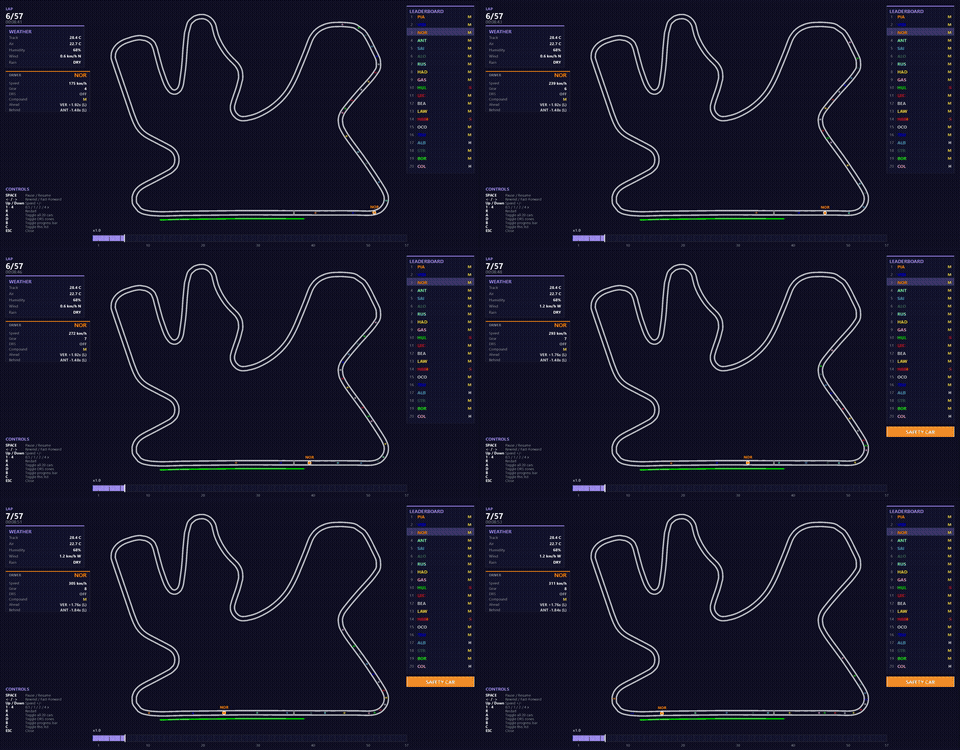
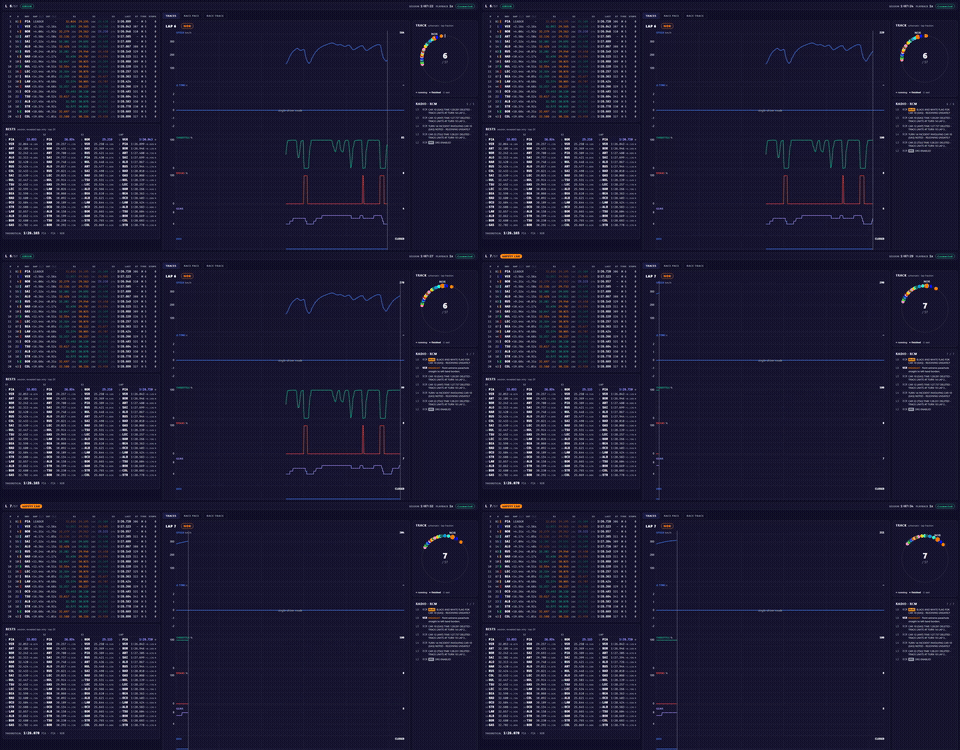
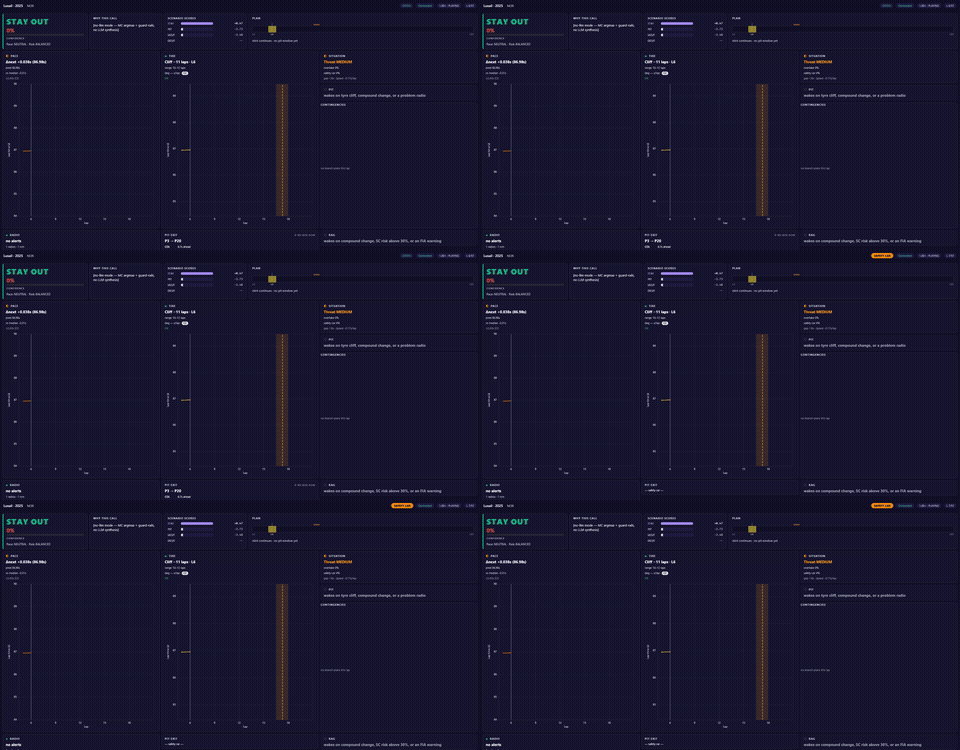
Three surfaces, one engine: the 2D arcade replay, the CLI wizard, and the React web app.
One instant, three windows.
The arcade runs as a pyglet replay plus two PITWALL windows. The three clips are cut from one deterministic session and anchored on the Safety Car flip, so every column shows the same broadcast tick.
One command. One venv. No PyTorch dance.
pyproject.toml routes torch / torchvision to the right CUDA wheel per platform via [tool.uv.sources] — so there's no manual PyTorch step on Windows or Linux.
# install uv once per machine
$ curl -LsSf https://astral.sh/uv/install.sh | sh

# clone + install in one shot
$ git clone --recursive https://github.com/VforVitorio/F1-StratLab.git
$ cd F1-StratLab
$ uv sync

# run the interactive launcher
$ uv run f1-strat
There's still a race to win.
Where F1 StratLab is headed next: from anticipating rivals to live-race inference.
Modern frontend
Done: the React web app replaced Streamlit as the post-race UI, across six surfaces (dashboard, comparison, model lab, strategy, race, chat). The FastAPI backend stays.
Arcade, modernized
A web-native frontend for part of the live Arcade experience, running alongside the pyglet 2D replay: the web app's modern strategy and telemetry surfaces come to the trackside view.
Rival Agent
Anticipate each rival's next move and feed it to the orchestrator. Reactive becomes anticipatory.
Live race inference
Real-time OpenF1 WebSocket ingestion, plus adaptation to the 2026 regulation.
F1 LLM
A domain LoRA fine-tune for sharper strategy reasoning and narration.
Radio NLP
A large team-radio corpus with a novel bluffing / deception signal.
MLOps studio
Button-driven retraining: download, merge, inspect, retrain. No notebooks.
Race-time bot
Live narration of the orchestrator on X during a Grand Prix.
Planned, not committed. Directions, not deadlines.
Frequently asked questions
What is F1 StratLab?
F1 StratLab is an open-source Python system that uses seven machine learning models and six LangGraph sub-agents to generate real-time Formula 1 race strategy recommendations, including pit-stop timing, tire compound selection, and undercut opportunity detection.
What ML models does F1 StratLab use?
XGBoost for lap-time prediction (MAE 0.410s), a Temporal Convolutional Network with Monte Carlo Dropout for tire degradation, two LightGBM classifiers for overtake (AUC-ROC 0.876) and safety-car probability, a HistGradientBoosting quantile regressor for pit-stop duration (MAE 0.487s), a LightGBM classifier for undercut success (AUC-ROC 0.771), and a four-stage NLP pipeline (Whisper + RoBERTa + SetFit + BERT-large) for team radio.
How does the tire degradation model work?
The Tire Agent wraps a causal TCN trained with Monte Carlo Dropout to produce P10/P50/P90 degradation quantiles per compound, detect the tire performance cliff, and output a recommended pit window with a calibrated confidence score.
How does the RAG agent handle FIA regulations?
The RAG Agent indexes the FIA Sporting and Technical Regulations (2023–2025) in a local Qdrant vector database using BGE-M3 embeddings, retrieves the top passages by cosine similarity and synthesizes a cited answer referencing specific article numbers.
What data does F1 StratLab use?
Telemetry, lap data, and race-control messages from 70 Formula 1 Grand Prix across the 2023–2025 seasons, sourced from the FastF1 and OpenF1 public APIs. The dataset is published at VforVitorio/f1-strategy-dataset on Hugging Face.
Open source. Yours to fork.
Spot a bug, ship a new agent, tune a model — issues and pull requests are welcome.

Víctor Vega
Also known as VforVitorio. Junior AI Engineer at NTT DATA Spain, working across many areas of AI, from computer vision to LLM behavior, agentic AI solutions, and tooling such as Model Context Protocol (MCP) servers. Bachelor's in Intelligent Systems Engineering at UIE Campus Coruña, graduated with a 9.0/10 average and 4 Distinctions (Matrícula de Honor), with a thesis awarded Distinction (Matrícula de Honor) and recommended for conversion into a research paper. Now pursuing a Master's Degree in Artificial Intelligence Research (AEPIA / UIMP) alongside his full-time role. Building AI for Formula 1, from telemetry modelling to multi-agent reasoning.